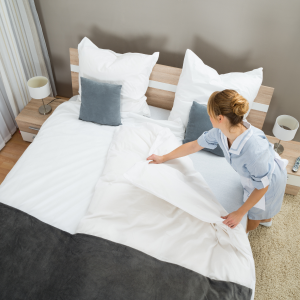
We must be mindful about the selection, hiring and training of housekeeping staff as potential avenue to identify, upskill and promote women to leadership positions. Too many housekeepers are represented in stereotypical roles in the hotel business.
Contributed by Angella Reid, COO, Heritage Consulting by B+R, Las Vegas
Nothing repels paying guests more than housekeeping standards that are below par. A hotel’s cleanliness quotient sets the tone for quality service while good housekeeping is the surefire way to enhance guest experience and improve a hotel’s bottom line.
According to the March 2, 2021, report of the Bureau of Labor Statistics more than 88% of hotel housekeepers are women with over 67% being people of color.
There are historical, structural and cultural issues which determine the operational roles women get to play in the hospitality workforce that impacts their status as well as opportunities within the industry. It is time to remake the people strategy model of how the hotel industry is operated.
As we work our way out of the COVID pandemic, the service industry is experiencing severe shortages of labor. There are varied opinions about why folks are not rushing back to their old jobs. Are extended, enhanced unemployment benefits to be blamed? Is it also true that these jobs are more physically challenging, without the commensurate pay package? Probably and particularly for women, childcare solutions are still unavailable due to the pandemic. I think that this so called “pandemic pause” has allowed employees to take stock of the jobs from which they got laid off or furloughed. They used the time to re-evaluate the last value on their efforts versus compensation ratio. Never in my lifetime have we faced the opportunity to step back from work and assess our jobs without feeling duly pressured.
The unplanned sabbatical demands both employers and employees recalibrate their norms to match up to the demands of the emergent economy. Not every industry can play in the remote and gig economy field. Hospitality is one such sector that entails a face-to-face engagement to achieve its full potential in servicing intentions and meeting expectations.
I don’t want to be served by a robot when I visit a hotel, or I’d have rather stayed home. I might possibly select a “robot-led” hotel specifically if I was seeking out that experience but, generally speaking, I prefer the human touch.
With the pandemic pause comes the fallout of women leaving the hospitality industry over age old societal expectations upon them to step up to fill in for the unavailable child-care service providers and other important roles as caregivers.
This is undoubtedly a setback for achieving closure on gender parity that we have been pursuing for many years. This shift will also negatively influence the rise of women to leadership roles in the hotel industry even as they consider other job opportunities or, simply choose to stay at home.
This got me thinking about how we may reshape and switch our paradigm around women generally employed in the poorly perceived, lower economic status jobs like housekeeping in the hotels business.
We do not need to look very far to find a ready supply of future hospitality leaders as we can tap into and grow this pipeline of our future leaders.
The hospitality industry does not suffer from a lack of female representation. On the contrary, it enjoys an abundance of women at low paygrade levels with little focus or a plan to develop and uplift them. This is what really ails the industry.
According to Julia Campbell, founder of Women in Hospitality, in 2017 the hospitality sector workforce was comprised of 55.5% women but was still dominated by men in managerial positions. As per the Castell Project report in 2019, only 11% of hotel company leadership positions (managing director, president, partner, CEO) are held by women. The report goes on to suggest that the odds of a woman reaching the top leadership status, are one woman to eight men.
I launched into my hotel career right out of high school with no idea it would become my life’s career and passion. My rise up the ranks was due to early years of mentorship and a conviction to work harder and more efficiently at the vocation I chose to pursue.
I consistently demonstrated a “can do” attitude to key stakeholders and outside influencers, being a quick study and showing the commitment to put in the time. I believed in myself, and people believed in me, investing their time and knowledge to guide my journey towards success.
Of course, there were times I lost faith in my ability to rise up the ranks in hotels, but each time I talked myself off the ledge more determined, never to wallow in self-pity nor to be crushed by the weight of failures and, criticism from others.
It is an industry I love and benefit from – one to which I made valuable contributions and has contributed to my own success. I made it a point to gain job experience at the front desk, housekeeping, HR, engineering, food & beverage because I wanted to understand the whole model. I never wanted to be labelled as a rooms or F&B person but, as a generalist. Along this journey I grew to understand the impact of the work of our housekeepers.
I have witnessed firsthand the crap they encounter in rooms, the carts they push from floor to floor, the pressure they face when front desk needs the room rush cleaned, etc. It’s backbreaking work. Somehow, though, few housekeepers rise up through the ranks and become senior leaders.
I think there are various reasons for this. For me, two reasons are clearly evident.
First, housekeepers generally prefer to stay in the background as they often feel unequal to colleagues who serve at the front end of the hotel. Second, the brighter stars often don’t wish to move into leadership fearing longer work hours with less opportunity for overtime, when they turn “exempted,” and because they are usually the (sole) breadwinners in their families. They need to earn incremental income from “buying rooms” (being paid for cleaning a number of rooms over and above their assigned daily quota) and doing overtime whenever possible.
Room attendants have traditionally been females, mostly from lower income backgrounds, who often do not speak the local English language, fairly fluently and, often times have families to support. Women who I knew in housekeeping generally felt their jobs were less dignified when compared to employees who worked on the front desk.
How many hotels demonstrate to room attendants the true value they bring to the success of a hotel by investing in their career development? We are mostly focused on how to improve their productivity.
Source: hotelsmag.com